

BASEBALL BAT BUYING GUIDE Everything you need to know before buying your baseball bat.
Sizing Guide
JustBats wants to help you purchase the correct size of baseball bat for you or your player! Below you will find a Bat Length Calculator that will determine the correct length of bat for your player based on their height and weight. As you scroll down the page, you will also find assistance for selecting the correct weight of a bat.
And if you need some additional assistance, you can always seek help from the Bat Coach -or- from our very own Bat Experts via email: experts@justbats.com, Live Chat or by phone: 1-866-321-2287!
LENGTH
BAT CALCULATOR

MOST POPULAR LENGTH BY AGE
| AGE | 5 - 7 | 8 - 9 | 10 | 11 - 12 | 13 - 14 | 15 - 16 |
|---|---|---|---|---|---|---|
| LENGTH | 24" - 26"SHOP NOW | 26" - 28"SHOP NOW | 28" - 29"SHOP NOW | 30" - 31"SHOP NOW | 31" - 32"SHOP NOW | 32" - 33"SHOP NOW |
GENERAL BAT LENGTH TIPS
The following methods provide general suggestions for an appropriate bat length for your player. (Note: These methods are not an exact science, but rather meant to provide a ballpark estimation.)
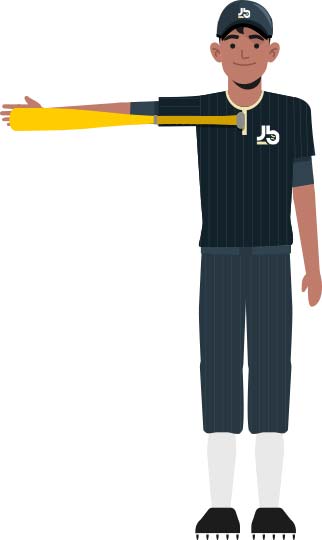
Extend the knob of your bat from the middle of your chest to the end of your hand. If only your fingertips can wrap around the bat, you are on the right track!
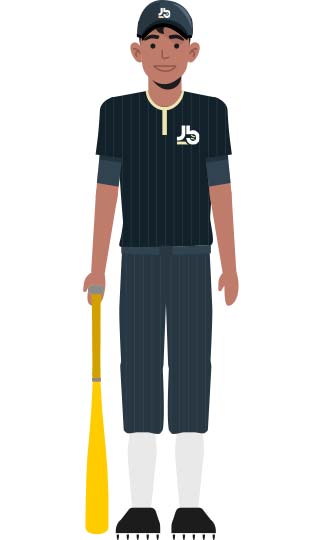
Place the barrel of the bat flat on the ground next to you. Relax your arm by your side. The goal here is for the knob of the bat to gently touch your palm. If so, the size is close!
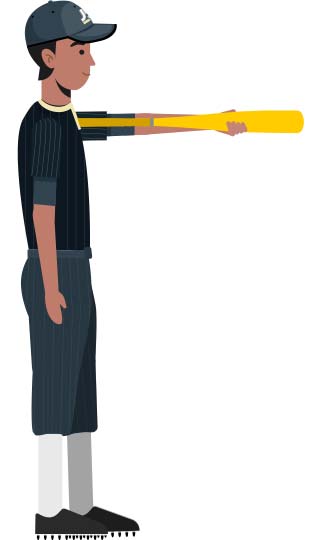
Place the bat’s knob on your sternum and let the bat extend out anteriorly. If you can grab the barrel of the bat, then the length should be excellent for use!
WEIGHT
If you are looking to increase in weight, a general recommendation for selecting a bat weight would be getting a bat that weighs 1-2 ounces heavier than the previous bat your player used. As well, understanding “the drop” or “length to weight ratio” will be helpful in determining the correct weight. Look below to view the formula for determining "the drop" of a bat -and- also to check out the most popular drop sizes by age!
Bat Length (in.)
- Bat Weight (oz.)
= Weight Drop
Example: a 33 inch bat that weighs 30 ounces is a -3 or "drop 3".
MOST POPULAR DROPS BY AGE
| AGE | 4 - 6 | 7 - 11 | 12 - 14 | 15 & above |
|---|---|---|---|---|
| DROP | -11, -12, -13 | -8, -10, -11, -12 | -5, -8, -10 | -3 |
| SHOP NOW | SHOP NOW | SHOP NOW | SHOP NOW |
GENERAL POINTERS
-
Bigger, stronger players usually prefer a heavier bat for the highest power potential. Smaller, contact hitters usually prefer a lightweight bat that allows for excellent swing speed and precise bat control.
-
The combination of bat length and weight will be the main determinant of a player's overall hitting experience. Consider trying teammates bats to determine the correct size for your player.
-
Make sure the feel of the baseball bat will be what is desired by the player. Generally speaking, most baseball players (and nearly all players below 12 years old) will be attracted to balanced bats. However, as players get older, they may develop into power hitters and look for an end-loaded bat to assist with their power.
-
Learn the governing body certification that your bat will need before you begin shopping. High school and older players will need BBCOR rated bats. Players younger than high school will need a baseball bat that is either USSSA certified or USA certified depending upon the requirements of your league. For beginners, you might even need a Tee Ball Baseball Bat.
YOU'VE CHOSEN YOUR BAT! WHAT'S NEXT?
Use your baseball bat as much as possible. Take it to the sandlot, to batting practice, or shoot you can even take it to bed with you! Just make sure that you are confident in it from the moment you step into the box for your first at-bat. And if you want to give your bat some extra care, check out our Bat Care page to keep your bat game-ready for the whole season.
*Our Customer Coaches at JustBats want to help! They can be reached through EMAIL at experts@justbats.com. You can CHAT with them through the LIVE CHAT feature. And lastly, they can take your TOLL-FREE CALL at 1-866-321-BATS (2287)!
Leagues
As you begin to enroll in new baseball leagues it will become very important to know the governing bodies that oversee your play. These governing bodies, such as USSSA & USA Baseball, will dictate your league's bat standards. All baseball bats will clearly display the governing bodies that approve the bats on the taper of the bat (where the handle meets the barrel). The following information will help breakdown the notable levels of play, governing bodies and their bat requirements.
T-BALL
Drop Weights: -10 to -13.5
Barrel Diameters: 2 1/4" - 2 5/8"
 All current bats built for use in tee ball will feature the USA stamp and be allowed for play in any league.
COACH PITCH
Drop Weights: -10 to -14
Barrel Diameters: 2 5/8" - 2 3/4"
USSSA
Drop Weights: -12, -11, -12, -10, -8, -5
Barrel Diameters: 2 5/8" - 2 3/4"
USA
Drop Weights: -13, -12, -11, -10, -8, -5
Barrel Diameters: 2 1/4" - 2 5/8"

BBCOR
Drop Weights: -3
Barrel Diameters: 2 5/8"

Bat 101
This section will help you learn about the different parts of a bat. Including bat materials, overall construction types, swing weights, and barrel diameters.
BAT COMPONENTS

-
KNOB: Allows a place for the batter's bottom hand to rest when swinging the bat.
-
HANDLE: Where a batter will grip when swinging. Typically, the handle will be covered by a bat grip or tape.
-
TAPER: This section of the bat is where the barrel thins into the handle.
-
BARREL: The largest area of the bat, specifically designed to create the best results on contact with a baseball.
-
END CAP: Meant to seal the barrel from the outside. New innovations allow some end caps to deliver more balance and reduce vibrations.
LENGTH & WEIGHT
-
LENGTH is the measurement (in inches) from the bottom of the knob to the top of the end cap.
-
WEIGHT in bats is measured in ounces. Bats may vary slightly from their listed weight as a result of cosmetic additions during the manufacturing process.
-
DROP is the difference between the length of the bat and the weight. Leagues can have a drop restriction so be sure to know if your league has requirements on drop sizes before making a purchase.
BARREL DIAMETER
Baseball bat barrel diameters come in a few different sizes. The diameter measurement (in inches) is recorded by measuring the total distance through the thickest part of the barrel. The larger the bat's barrel diameter, the larger the overall hitting surface will be. As a result, we recommend swinging the biggest barrel diameter that your league will allow.
Please refer to our Leagues section if you are unsure of your league's barrel diameter rules.
ONE-PIECE VS. TWO-PIECE
-
ONE-PIECE bats feature a single piece of material from the knob to the end cap.
-
It provides a stiff feel when connecting with a ball.
-
This is the most traditional style of bat.
-
It is usually the most affordable style of bat.

-
-
TWO-PIECE bats feature a barrel portion and a handle portion that are fused together at a connection point.
-
These bats display barrel flex and limit vibration when hitting a baseball.
-
Since a two-piece design is more difficult to make, these bats will usually have higher price tags than one-piece bats.

-
BALANCED VS. END LOADED
-
BALANCED swinging bats are going to be bats that have an even weight distribution from the end cap to the knob. These bats are the easiest to control and are excellent for contact hitters.
(Nearly every baseball bat sized -10, -11, -12 & -13 will be balanced)

-
END-LOADED bats have extra weight put into the barrel. These bats are intended to be used by power hitters who will benefit from the extra barrel weight by achieving higher exit velocities and more distance on contact.

BAT MATERIAL
Here are the most popular Baseball Bat Materials:

-
COMPOSITE
Pros:
The two-piece design allows for less discomfort on the hands during a miss-hit.
Because weight can be placed precisely throughout the bat, these bats are usually the most balanced feeling.
Typically, these bats can feature longer barrels (bigger sweet spots) that don't feel extra heavy.
Cons:
Since composite material is the most difficult bat material to create, these bats are usually the most expensive.
The layered material usually requires a little bit of a break-in period to allow it to perform at the highest level.
Composite bats seem to break down a little easier when compared to alloy barreled bats (especially when temperatures sink to near 50-60 degrees fahrenheit).
SHOP COMPOSITE BATS
-
ALLOY
Alloy bats are built from walls of material put together to create the bat. Traditionally, these bats have felt more end-loaded when compared to composite bats. However, in recent years, manufacturers have found the ability to make these bats feel pretty balanced. As well, alloy bats are most commonly made in the one-piece design.
Pros:
Alloy material is easier to make than composite material and alloy bats can be sold at a lower price in most cases.
Older and stronger players usually enjoy the stiff feel of one-piece alloy bats. They feel as though all their power gets transferred into the swing and no power is lost.
Sometimes these bats are referred to as "cold weather" bats. Although, it is hard to say that any bat is truly a "cold weather" bat, alloy bats do seem to hold up when temperatures drop to around 50-60 degrees fahrenheit.
No break-in period is required. Alloy bats are ready to perform at the top level on day one.
Cons:
Younger players can find these bats to feel a little end-loaded.
When compared to a composite bat, it could feel that the sweet spot on an alloy bat is smaller.
The one-piece design can cause discomfort if the ball is not hit on the sweet spot.
SHOP ALLOY BATS
-
WOOD
Wood bats are most commonly built from a single piece of ash, maple or birch wood.
There are some wood bats built with a combination of two types of wood. As well, some wood bats have "man-made" materials incorporated into the construction. These types of wood bats are generally more durable than traditional single-piece wood bats and are often called "composite wood bats".
Pros:
For younger players, wood bats are a little heavier than aluminum or composite bats and can help promote more strength in a swing.
Wood bats encourage players to consistently hit the ball on the sweet spot. This is because wood bats are not forgiving in their feel when a baseball is not squared up on the barrel.
They're a blast to swing! It is always fun using bats similar to what the big leaguers use!
Cons:
Wood bats are the lowest performing bats out there. You'll still be able to hit the ball hard and experience a great feel when you connect on the sweet spot, but hits typically don't travel as far or as hard as what you see with aluminum or composite bats.
These bats can break if you're facing a thrown pitch that has decent velocity and you don't connect with it on the barrel.
SHOP WOOD BATS&url=http%3a%2f%2fwww.justbats.com%2fbuying-guides%2fbaseball-bats%2f)
